
There was a time when the word “cybercrime” sounded distant and cinematic. It belonged to
movies filled with glowing monitors, encrypted files, masked hackers, and giant corporations
under attack. The threat felt technical, specialized, and far removed from ordinary life. Most
people imagined cybercrime as something dramatic enough to appear on the evening news.
But that version of cybercrime is only the visible edge of a much larger reality.
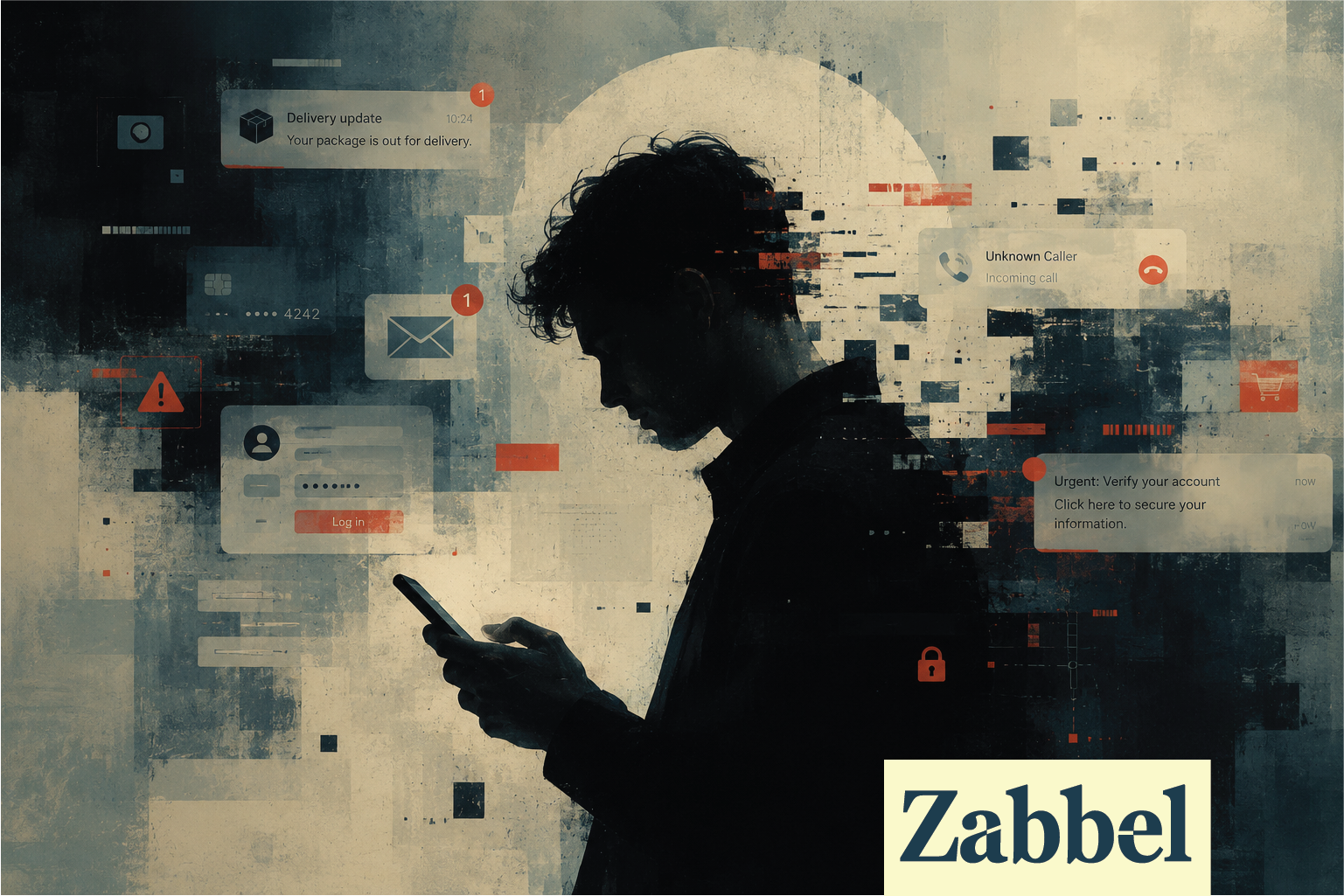
Today, cybercrime often arrives quietly. It appears as a message from a delivery company. A
fake banking notification. A login page that looks almost identical to the real one. A social
media account asking for help. A phone call from someone who sounds convincing enough to
trust. Sometimes it is not even an attack in the traditional sense. It is simply the slow and
invisible collection of personal information over time until someone, somewhere, knows
enough to manipulate, impersonate, or exploit another person.
What makes modern cybercrime dangerous is not just its scale. It is how ordinary it has
become.
Most people do not recognize cybercrime when they encounter it because it no longer
resembles the idea they were taught to fear. It blends naturally into digital life. And digital
life itself has become so deeply integrated into daily routines that people rarely stop to
question the systems they interact with anymore.
This misunderstanding matters more than many realize.
The public image of cybercrime is still shaped by exceptional events: massive leaks,
ransomware attacks against hospitals, breaches involving millions of users. These incidents
receive attention because they are large enough to interrupt normal life visibly. Yet the
majority of cybercrime operates below that threshold. It survives in small moments repeated
endlessly across the internet.
A manipulated link clicked in a hurry.
A password reused across multiple accounts.
A fake online store appearing during a holiday sale.
A teenager downloading a modified mobile app.
An employee opening an attachment that looked routine.
An elderly person trusting a voice on the phone.
None of these moments feel dramatic while they are happening. That is partly why
cybercrime succeeds.
The internet trained people to value speed and convenience above caution. Over the years,
digital systems became smoother, faster, and more frictionless. Platforms encouraged
automatic logins, saved payment information, synchronized devices, and one-click
interactions. Convenience became the central promise of modern technology.
And convenience changes behavior.
People no longer pause before opening links because digital communication is constant. They no longer examine websites carefully because interfaces are designed to feel familiar. They trust apps because apps are now part of everyday infrastructure. Even suspicion itself has become exhausting in a world where nearly every interaction passes through a screen.
Cybercrime thrives inside that exhaustion.
What many people still misunderstand is that modern cybercrime is often less about technical brilliance and more about human psychology. The stereotype of the elite hacker sitting alone in a dark room distracts from a simpler reality: manipulating people is usually easier than breaking machines.
A convincing message can bypass security systems more effectively than sophisticated code.
Fear, urgency, curiosity, loneliness, distraction, and trust are all vulnerabilities.
Cybercriminals understand this well because human behavior is predictable under pressure.
That is why phishing remains so effective despite years of public awareness campaigns. Not
because people are unintelligent, but because digital environments are built around speed,
multitasking, and emotional reaction. A person checking messages while commuting,
working, or dealing with stress is easier to manipulate than most cybersecurity advice
assumes.
The problem is not merely that people lack technical knowledge. The deeper issue is that
modern online life conditions people to operate automatically.
Most digital interactions now happen on instinct.
Swipe. Click. Accept. Confirm. Continue.
The internet became less like a place people consciously explore and more like an invisible
layer surrounding ordinary life. Banking, communication, transportation, healthcare,
education, shopping, work, and entertainment all depend on digital systems simultaneously.
The result is a kind of ambient dependence. People trust systems not because they fully
understand them, but because daily life would become almost impossible without them.
That dependence creates an environment where cybercrime no longer feels separate from
normal society. It exists inside society.
And the consequences extend far beyond stolen passwords or financial loss.
When people discuss cybercrime, they often focus on money because financial damage is
measurable. But some of the most significant effects are emotional and social. Victims
frequently describe feelings of humiliation, confusion, and self-doubt after being deceived
online. Even highly educated individuals can fall for scams designed around emotional
timing and psychological pressure.
There is a quiet cruelty in many forms of cybercrime. Scammers do not only steal
information; they exploit trust itself. Romance scams manipulate loneliness. Fake
emergencies exploit empathy. Fraudulent job offers target desperation. Identity theft attacks
the stability of personal identity in an increasingly digital world.
The emotional aftermath can linger long after financial damage is repaired.
At a broader level, cybercrime slowly weakens trust in digital systems altogether. Every fake
message, every fraudulent website, every manipulated account teaches people to become
more suspicious of online interaction. Over time, this creates a strange contradiction in
modern life: society depends more heavily on digital systems while simultaneously trusting
them less.
That erosion of trust has institutional consequences too.
Businesses spend enormous resources defending against fraud, data theft, and system
manipulation. Hospitals, schools, municipalities, and public services increasingly face attacks that disrupt operations rather than simply steal money. In some cases, the goal is not even financial gain but destabilization. The more connected societies become, the more vulnerable essential systems become to interruption.
Yet public understanding often remains stuck in outdated assumptions.
Many people still divide the world into “online” and “real life,” as though digital harm exists
in a separate category from ordinary social harm. But this distinction no longer reflects
reality. Losing access to a digital banking account affects real survival. False information
spreads into real political tension. Leaked personal data affects real employment
opportunities and relationships. Online manipulation increasingly shapes offline behavior.
Cybercrime is not happening somewhere else anymore. It is woven into modern social
structure.
This becomes especially important in smaller or developing countries, where cybersecurity
infrastructure and public awareness may lag behind rapid digital adoption.
In countries like Kosovo, digital transformation has accelerated quickly over the last decade.
Online banking, mobile services, digital communication, and e-commerce became integrated
into everyday life at remarkable speed. But awareness and institutional protection do not
always evolve at the same pace.
Smaller countries often face a difficult combination of vulnerabilities: limited cybersecurity
investment, fewer specialized professionals, fragmented institutional coordination, and lower public awareness regarding digital threats. At the same time, populations may rely heavily on social media and informal communication networks where misinformation and scams spread rapidly.
The challenge is not unique to Kosovo, but smaller states can feel the effects more intensely
because resources are more limited and public systems are less resilient to disruption.
A cyberattack against a major institution in a large country may be absorbed with relative
stability. In smaller systems, even moderate disruptions can create disproportionate
consequences. A breach affecting healthcare, public records, financial systems, or energy
infrastructure can quickly become a wider social issue rather than merely a technical incident.
There is also a cultural dimension that often goes unnoticed.
In societies where personal trust and close social networks play a strong role in
communication, social engineering can become especially effective. People are more likely to
trust familiar names, local references, or messages appearing to come from known
individuals. Cybercrime adapts itself to social environments remarkably well. It studies
habits, language, behavior, and emotional patterns.
That adaptability is part of what makes cybercrime so difficult to confront. It evolves
alongside society itself.
And perhaps this is the most uncomfortable realization: cybercrime does not represent a
temporary disruption of the digital age. It is a byproduct of the digital age.
Every system that increases convenience also creates opportunities for exploitation. Every
platform that simplifies communication can also simplify manipulation. Every technology
that reduces friction can reduce caution at the same time.
This does not mean society should reject technology or retreat into fear. The internet remains one of the most transformative tools ever created. Digital systems connect people, expand opportunity, and improve daily life in countless ways.
But understanding cybercrime requires abandoning the fantasy that technology alone can
solve problems created by human behavior.
Cybersecurity is often discussed as though it belongs exclusively to engineers, governments,
or IT departments. In reality, it has become deeply connected to sociology, psychology,
communication, education, and public trust. The central issue is no longer just whether
systems can be protected technically. It is whether societies can maintain healthy forms of
trust and awareness while living inside permanently connected environments.
That is a far more complicated challenge than most headlines suggest.
Because the modern cybercriminal rarely needs to overpower a system completely. Often,
they only need a brief moment of distraction, confusion, urgency, or misplaced trust.
And in a world built around constant digital interaction, those moments happen every day.
Perhaps that is why cybercrime remains so misunderstood. People continue searching for
dramatic signs of danger while overlooking the quieter reality unfolding around them. The
threat does not always announce itself loudly. More often, it hides behind familiar interfaces,
ordinary conversations, and routines repeated so frequently that they no longer feel risky.
The most dangerous part of cybercrime is not that it feels foreign.
It is that it feels normal.
________________________________________________________
Explore more articles on Zabbel Publications
Watch explainers and documentaries on Zabbel YouTube Channel

Leave a Reply